For patients and researchers
The Body Guitar Theory
This theory is placed here so it can be proven or disproven. The attempt to do either furthers our understanding of stability.
Dr. Sean M. Wheeler, M.D.
Mammals are the only species with a muscular diaphragm—a dome-shaped skeletal muscle essential for efficient respiration and motion. This adaptation evolved to support the active lifestyles of warm-blooded animals, but in humans it intersects uniquely with posture and movement because of bipedalism. Humans are the only mammals that maintain an upright posture when running or at rest, a trait that emerged during our evolutionary transition from quadrupedal ancestors around 4–7 million years ago. That shift reshaped the pelvis, lower limbs, and spine. It also came at a cost: the spine evolved rapidly from a straight, quadrupedal design to an S-shaped curve to balance the body over two legs. This evolutionary compromise introduced inherent instability.
The human spine is not fully optimized for constant upright loading. Disc herniation, facet joint pain, and vertebral slippage are far less common in quadrupeds, where the spine hangs horizontally like a suspension bridge. The high prevalence of back pain among humans—up to 80% of adults at some point—is not a mystery once you take that seriously.
Wood and strings
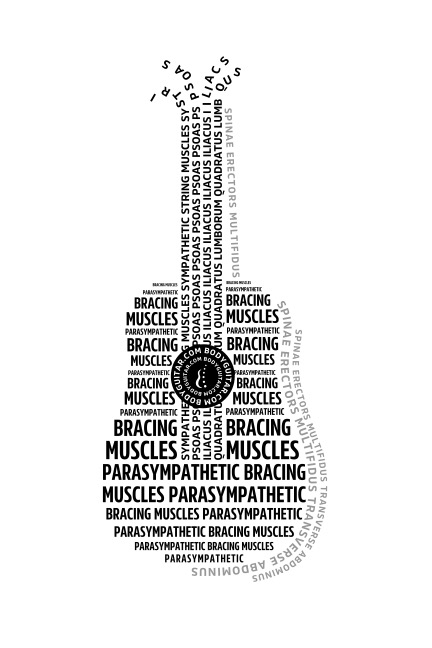
The Body Guitar Theory, as outlined in UPRISE: The Body Guitar Theory and Back Pain Liberation, explains this human-specific instability. The body relies on two opposing muscle groups for stability: the “wood” (bracing muscles) providing foundational structure, and the “strings” (dynamic muscles) enabling active tension and movement.
In quadrupeds those systems are balanced for horizontal locomotion. In humans, bipedalism demands constant upright alignment against gravity. The small, high-tone bracing muscles must be stronger. These muscles are parasympathetic in nature. They promote relaxed endurance and pull joints inward for mid-air suspension without effort. Examples include the multifidus for spinal segmentation, external hip rotators for centering the femoral head, soleus for lower-leg grounding, intrinsic foot muscles for arch support, and deep neck flexors for cervical alignment. They evolved to pull us upright, countering the pull of string muscles throughout the body, including hip flexors like the psoas. This unique human difference must be fought for every day. If not, we drift back into a hip-flexor-dominated posture.
When instability arises—as we age and become sedentary, or from facet pain, disc bulges, and nerve irritation—bracing muscles become inhibited. The body compensates with overuse of sympathetic string muscles. The psoas and other hip flexors, which are not bracing muscles, tighten. Anatomically linked to the diaphragm by fascia, ligament, and nerve, that tightening locks the diaphragm, shifting breathing from deep abdominal patterns to shallow chest breathing. High sympathetic tone follows. Bracing muscles weaken further. The cycle feeds itself.
To reverse this, the theory advocates consciously practicing abdominal (diaphragmatic) breathing and relaxed posture during daily activities and targeted exercises. That activates the bracing muscles and builds their endurance-based tone over time—much like tuning a guitar for harmony—without forcing constant contraction.
The claims, numbered
- Bracing muscles are high-tone endurance muscles that provide static stability and posture by pulling joints into themselves. These muscles are uniquely human and provide parasympathetic stability, in balance with sympathetic string muscles.
- When in pain, bracing muscles are inhibited from pulling the painful joints into themselves by arthrogenic muscle inhibition. The body compensates by overusing sympathetic string muscles, and those compensations further inhibit the bracing muscles.
- In the lumbar spine and hip, where stability is of utmost importance, chest breathing and string-muscle contraction become the dominant mode of stability when back pain persists.
- Dominant contraction of the string muscles of the lumbar spine also inhibits bracing muscles of the hip. Long-term inhibition leads to atrophy. When those hip muscles fatigue, string muscles take over, inhibiting the bracing muscles of the lumbar spine, causing a cycle of back and/or hip pain and weakness.
- Because bracing muscles are parasympathetic and string muscles are sympathetic, this cycle increases sympathetic tone throughout the body and affects health in many adverse ways.
- To regain bracing-muscle strength, pain must be resolved. Strengthening must then involve diaphragmatic breathing, relaxation of string muscles, and decreasing sympathetic tone so the bracing muscles can contract fully and unopposed. That returns the balance between bracing muscles and string muscles.
This theory changes the message on posture and diaphragmatic breathing. It brings the biomechanical and biopsychosocial models together. It embraces previous theories on spine stability and adds to them. The goal of the Body Guitar Theory is to get your body in tune.
A walking tutorial is already public. It is a teaser, not a do-it-yourself rewrite of the method. The protocol must be added after you understand your unique issues with a qualified physical therapist or Wheeler Walking Method professional. Read the walking teaser.