Low back
Back pain is complicated. The algorithm is not a diagnosis.
Low back pain is the most common cause of disability worldwide, and still there is no defined answer the industry agrees on. One consensus paper in 2013 said that in a great majority of cases there is no possible diagnosis. That sentence has done a lot of damage.
Years ago, when disc bulges were found to irritate nerves and steroid epidurals were found to help that irritation, anesthesiologists were a natural fit. They already did epidurals. The problem was that not all back pain comes from discs. Deciding what to do next required a physical exam and an advanced diagnostic skill in low back pain. That is not what the algorithm was built to do.
So a recipe took over: if it hurts here, do this. If that works, do this. If it doesn’t, do that. Insurance companies paid for the recipe. In a significant number of cases, the recipe does not work. Spinal cord stimulators cover pain for a while. Labels like failed back syndrome and myofascial syndrome often mean “we don’t know.” Patients get denied a diagnosis, a plan, and then offered medications that are harmful.
Ask yourself: did someone do a detailed exam? Did they look at you, or just the MRI? Did you leave with a diagnosis, or an explanation of the algorithm? At Body Guitar Clinic, you will get a diagnosis. Sometimes we have to unravel several problems. There is a large and significant difference between a differential diagnosis and an algorithm.
Facet joint pain
Outside of muscle spasm, facet joints are the most common cause of low back pain. They are the joints where movement happens. They get hurt when the joint is impacted against itself, or when the muscles around the joint are not holding it stable. People with facet pain hurt getting up in the morning or after sitting. They lean over counters and shopping carts and avoid back-bending.
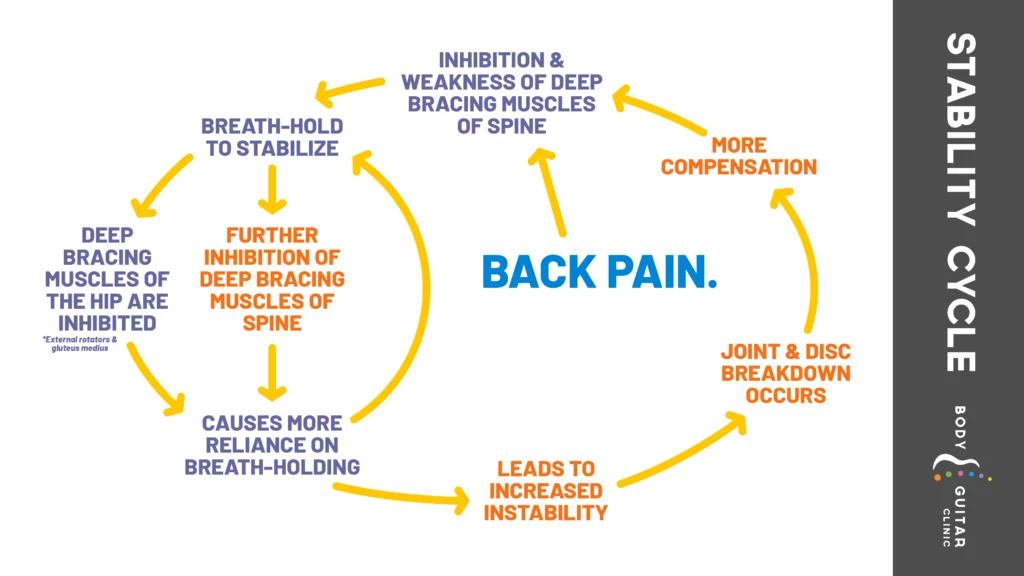
Treatment starts by settling the inflammation—anti-inflammatories, a steroid injection, or radiofrequency ablation of the nerves to the joint. The decrease in pain has to be large enough to treat the weakness, instability, tightness, and compensation that arrive quickly. Treating the joint without treating what follows is how facet pain becomes a subscription.
Sacroiliitis
The SI joint sits between the sacrum and the ilium. It is meant to be essentially unmovable. If the back is not stable from facet pain and you sway as you walk, you load those ligaments with every step. Eventually they stretch. Then the joint moves. Then it inflames.
Most people remember the day SI pain started. Pain goes from “I did this today” to “it hurts every day no matter what I do.” Sitting too long makes you want to stand. Standing too long makes you want to sit. Walking, lying down, holding something heavy in one arm—none of it is free. To settle an SI joint you have to walk better. To walk better you need stabilizer strength. To get that strength you have to settle the facets and correct posture.
Disc findings are not a destiny
There is a difference between bulge, herniation, protrusion, and extrusion. Not enough of a difference to change the conversation about where they came from and what to do. Studies have shown about 35% of 20-year-olds with no pain have disc bulges on MRI, and about 60% of 60-year-olds. Less than half of people with MRI findings of disc bulge have the symptoms of disc bulge.
If you have been telling neighbors you cannot help them move because you have a disc at L5/S1 impinging L5, and you have no L5 weakness, no reflex change, and nothing down the leg that looks like L5, the MRI is not the diagnosis. Using an algorithm, back pain plus a disc bulge becomes a road toward surgery. If the disc has nothing to do with your pain, that road is a disaster.
Degenerative disc disease
This is a common label. In almost two decades of caring for back pain, Dr. Wheeler has yet to care for a single patient for whom this was the cause of their pain. Does it say the back is not stable? Yes. Is it the cause of the pain? No. Come in and get an accurate diagnosis.
Spinal stenosis
Stenosis is a narrowing in the spinal canal from arthritis, disc bulging, and/or ligament swelling. Most people have all of these. Stenosis often causes leg numbness after walking or moving for a while. Sitting and rest bring it down. Sometimes surgery is needed. Sometimes we can get the ligament swelling to decrease, then use physical therapy to keep it from coming back.
Sciatica, and pain that is not sciatica
Patients call any pain down the leg sciatica. For physicians, sciatica means something is irritating the sciatic nerve: a disc problem, or a piriformis spasm. Hip pain and sacroiliitis can make the piriformis spasm. Everything else is non-sciatic leg pain—facet pain, SI pain that does not irritate piriformis, hip pain that does not, hamstring pain, other medical problems.
If you have leg pain with bowel or bladder changes, call your doctor or the hospital immediately. Nerve damage that persists can become permanent. If you have leg pain without those changes, come see us and get an accurate diagnosis.
Failed back syndrome
The name often means the system failed someone. The most common path is the algorithm, then a surgery that was not needed, then pumps, stimulators, and medication. Sometimes there is surgical damage. Sometimes there are so many diagnoses stacked that a cure seems impossible. In most cases we can still help with diagnosis and a chance for improvement.